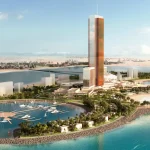


Wynn Al Marjan Island is routinely described as a $5.1 billion project, but that headline figure only tells part of the story. What’s more revealing is how Wynn Resorts is actually funding its share of that cost, how much cash has already gone out the door, and how the company itself is framing this investment to its own shareholders. Wynn doesn’t own the project outright, and the numbers behind its stake reveal a company committing real, ongoing capital years before the resort generates a single dollar of revenue.
The Ownership Structure Behind the Number
Wynn Al Marjan Island isn’t a wholly owned Wynn Resorts property. It’s being developed through a joint venture in which Wynn holds a 40 percent stake, alongside RAK Hospitality Holding and Marjan LLC as its local partners. That structure matters because the widely quoted $5.1 billion total project cost represents the full development, not what Wynn itself is contributing out of its own balance sheet.
Wynn’s actual financial exposure comes through as its share of that joint venture, funded in stages as construction progresses rather than as a single upfront payment.
What’s Already Been Spent
According to Wynn Resorts’ own fourth quarter 2025 results, the company contributed $79.2 million in cash to the joint venture during that quarter alone. That single quarter’s contribution brought Wynn’s total life to date cash contributions to the project to $914.2 million.
That figure is worth sitting with for a moment. Nearly a billion dollars has already moved from Wynn’s own accounts into a resort that, at the time of that report, was still under construction with an opening more than a year away. This is capital already spent, not capital pledged, well before the property has generated any income to offset it.
What’s Still to Come
Wynn has also laid out a fairly specific forward funding schedule. The company expects to contribute between $375 million and $400 million in equity to the project during 2026, followed by a further $75 million to $100 million in 2027, the year the resort is actually expected to open. Beyond that, Wynn estimates its total remaining equity contribution to the project, covering everything left to fund from this point forward, at between $450 million and $550 million.
Stacked against the $914.2 million already spent, that remaining commitment brings Wynn’s total investment in Al Marjan Island to somewhere in the range of $1.36 billion to $1.46 billion once the project is fully funded, assuming those estimates hold. That’s a substantial sum for a 40 percent stake in a single resort, and it’s being deployed on a fairly tight schedule, with the bulk of the remaining spend concentrated in 2026, the final full year before opening.
What Wynn Expects to Get Back
The company isn’t funding this purely on faith. Wynn has projected that Al Marjan Island will add $345 million of EBITDAR, meaning earnings before interest, taxes, depreciation, amortization, and rent, to its existing base once the resort is operational. EBITDAR is the standard profitability measure used across the hotel and casino industry precisely because it strips out financing and property structure differences, making it the clearest like for like comparison to Wynn’s other properties in Las Vegas and Macau.
That $345 million projected contribution needs to be read against what the company is actually risking to get there. Roughly $1.4 billion in total equity contributions, funding a stake expected to generate $345 million in annual EBITDAR, implies Wynn is pricing this investment on a payback timeline of roughly four years once the resort reaches a stabilized run rate, though actual performance in a genuinely new market always carries more uncertainty than that simple math suggests.
A Company Still Absorbing the Cost Before the Payoff
It’s worth noting that Wynn Resorts’ overall net income for 2025 came in at $327.3 million, down from $501.1 million the prior year. The company hasn’t attributed that decline specifically to Al Marjan Island spending in public commentary, and net income moves for reasons well beyond any single project, so it would be a mistake to draw too direct a line between the two figures. But the timing is a useful reminder that Wynn is absorbing real, present day costs on a project that won’t contribute meaningfully to earnings until after it opens. That’s a normal pattern for large scale resort development, but it does mean current Wynn Resorts financials reflect a company mid investment rather than one already collecting a return.
How Confident Is Wynn, Really?
The scale of ongoing spending lines up with increasingly confident public commentary from Wynn’s own leadership. CEO Craig Billings previously estimated the UAE market’s gross gaming revenue potential at $3 billion to $5 billion, while acknowledging at the time that the company saw “two incremental competitors” potentially entering the market. More recently, in a March interview, Billings revised that framing upward, citing analyst estimates in the $5 billion to $8 billion range and noting that, with no confirmed competition yet announced, there was probably some conservatism baked into even those higher numbers. For context, he pointed out that the entire Las Vegas Strip generates a little more than $6 billion in gaming revenue annually, meaning analysts are describing a single UAE market opportunity potentially rivaling an entire established gaming destination.
That shift in tone, from a cautious range with named competitors in mind to a more bullish estimate with no confirmed rivals, tracks with the increasing capital commitment. Companies rarely accelerate spending into an opportunity they’ve become less confident about.
The Bigger Picture Around the Spend
Wynn’s capital commitment to Al Marjan Island also isn’t happening in isolation. In 2025, the company acquired Crown London, an exclusive casino in London’s Mayfair district. Billings has described that acquisition as strategically significant despite its modest dollar value, framing it as a way to build a database of affluent international gamblers who could become future Al Marjan Island visitors. That’s a relatively small additional investment, but it signals Wynn is spending beyond construction costs alone to build the customer pipeline the resort will eventually need.
The Bottom Line
By the time Wynn Al Marjan Island opens, Wynn Resorts will likely have committed somewhere close to $1.4 billion in total equity to a project it owns 40 percent of, funded in stages that accelerate through 2026 and taper off after the resort’s 2027 opening. That’s a meaningful bet for a single market entry, made well before any revenue arrives to offset it, and it’s being made at a moment when the company’s own public estimates of what the UAE market could be worth have only grown more optimistic, not less.